Accessibility · Motor control
Motor control solutions
Motor control is "the ability to regulate or direct the mechanisms essential to movement" (Schell & Gillen, 2019). When a congenital condition, illness, or acquired injury changes that control, standard controllers can lock a person out. Adaptive hardware brings the game back within reach.
How motor control affects gameplay
Strength
The force available to press buttons and move a controller.
Endurance
Sustaining movement across an extended play session.
Bilateral movement
Operating systems that expect both hands together.
Timing
Pressing or moving within specific, sometimes tight, windows.
Official adaptive controllers
The console makers now build first-party accessibility hardware. These are the anchors most adaptive setups start from. Links go to the manufacturer’s own store.
Microsoft
Xbox Adaptive Controller
A reconfigurable hub for gamers with limited mobility. External switches, buttons, and joysticks plug in and remap. Those are bought separately to fit the player.
about $100 · Official store ↗Sony (PS5)
Sony Access Controller
Sony’s official accessibility controller kit for the PlayStation 5, built for players with disabilities and highly customizable out of the box.
about $90 · Official store ↗Logitech
Logitech G Adaptive Gaming Kit
A plug-and-play set of light-touch buttons, large buttons, and variable triggers, an accessory that expands the Xbox Adaptive Controller. A separate kit exists for the Sony Access Controller.
about $100 · Official store ↗Prices as listed by each manufacturer, 2026. Check the store link for the current figure.
Adaptive solutions
Adaptive controllers
Reconfigurable controllers (e.g. the Xbox Adaptive Controller) that accept external switches and remap inputs.
Buttons & switches
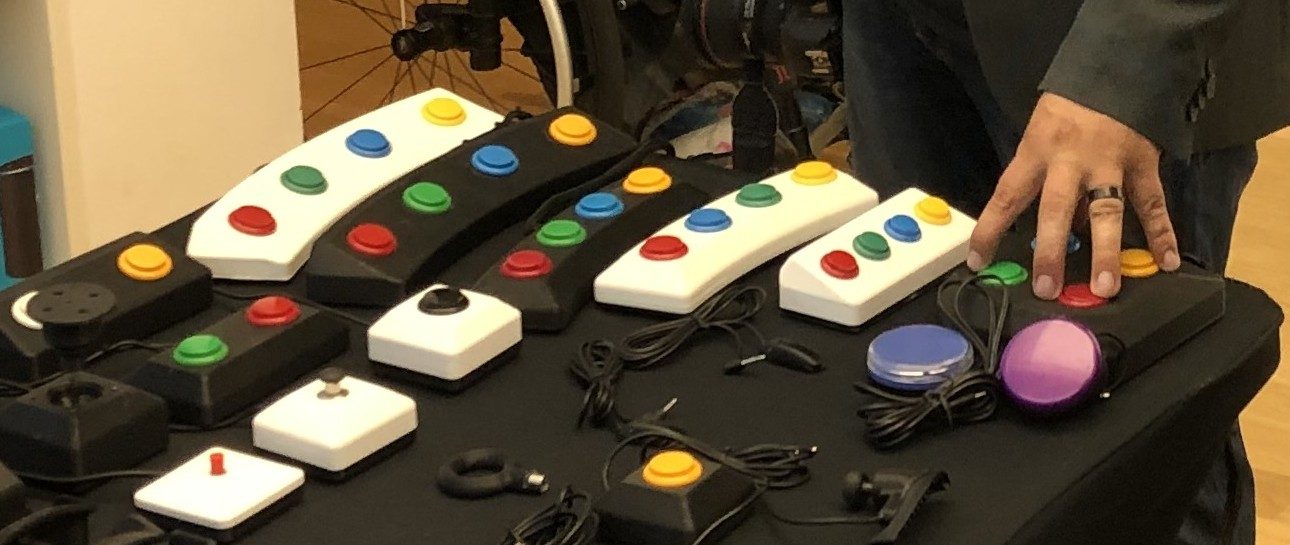
Large, light-touch, or specialty switches mapped to game actions for limited strength or range.
Buttons & switches →Joysticks
Alternative joysticks sized and weighted for the player’s motor profile.
Mounts, splinting & positioning
Mounting hardware and positioning so the controller meets the player, not the other way around.
Mounts, splinting & positioning →Misc. gaming solutions
One-handed layouts, remapping adapters, toggles for held inputs, and other targeted aids.
For purchases, start from the official manufacturer stores linked above.
Trusted external resources
- AbleGamers ↗: a charity creating opportunities that enable play to combat social isolation and improve quality of life for people with disabilities.
- SpecialEffect ↗: a UK charity helping physically disabled people play video games, using modified controllers and eye-tracking.
- Game Accessibility Guidelines ↗: a reference of accessibility features for game designers and evaluators.
- Can I Play That? ↗: accessibility-focused game reviews and guides, by disabled gamers for disabled gamers.
Need help matching hardware to a client? Our consultation service and evaluation tools can help.
Want hands-on help?
Stuck on a particular player, setup, or program? Tell us what you are working with and we will come back to you by email.
Email only, no phone. Unsubscribe anytime.